





New publication highlights latest guidance for tackling damp and mould
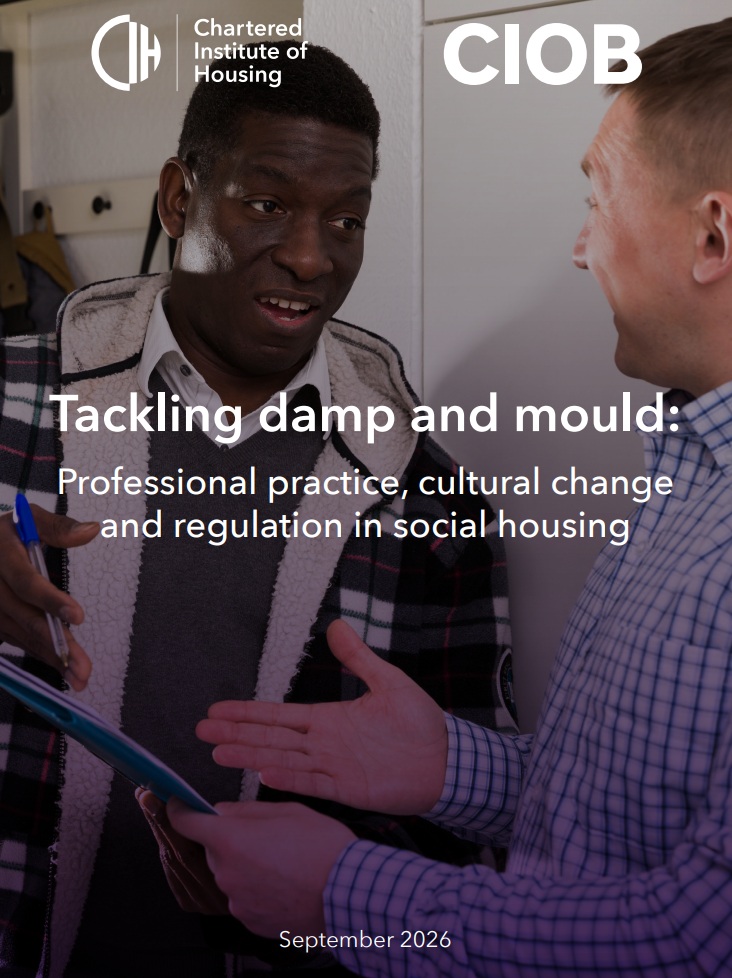
On 2 September 2026, the Chartered Institute of Building (CIOB) announced that it had partnered with the Chartered Institute of Housing (CIH) on a new publication about tackling damp and mould in England’s housing sector.
It builds on guidance CIH published in 2022, taking into account key legislative developments, such as Awaab’s Law and the Hazards in Social Housing (Prescribed Requirements) (England) Regulations 2025. It also includes a new section focused on the construction causes of damp and mould.
The guide, titled "Tackling damp and mould: Professional practice, cultural change and regulation in social housing" contains both practical guidance and a theoretical framework of how best to approach the dual problems of damp and mould.
Eve Blezard, policy lead at CIH and co-author of the report, said:
“A central part of a landlord's role is to provide safe homes for residents. Damp and mould are among the issues that can pose a significant risk to residents' health, and are often symptoms of wider problems in housing, including disrepair, inequality, stigma and systems under pressure. Tackling them well, with professionalism and genuine care for residents, is both a legal requirement and a measure of what kind of sector we want to be.
“At CIH we are clear that we must continue to support the sector on complex issues such as hazards within residents' homes and help set the standard for how professional values are understood and developed in practice, so that best practice is followed consistently.
“This guide is about resident safety, but it is also about being listened to and treated with respect. Addressing issues associated with damp and mould takes professionalism, empathy, and follow-through, and that is what we have set out to relay to our readers.”
The guide also provides landlords with advice on common scenarios such as recognising damp and mould when it is present in a home, problem solving with residents, taking steps to resolve root causes and responding to hazardous situations. Furthermore, issues around culture and stigma in relation to damp and mould are explored. Case studies from across the sector are included, providing real-world examples of innovative solutions and external collaborations that have benefited towns, tenants, children and families as well as combined authorities and housing associations.
David Barnes, head of policy and public affairs at CIOB, said:
“The new guide will be a valuable resource for our members across a wide range of roles and responsibilities, as the need to prevent and better deal with damp and mould quite rightly has become a higher priority. Maintaining a strong focus on every individual property’s building pathology rather than rolling out one size fits all measures to tackle damp and mould is key. The guide is designed to support professionals who build, retrofit and maintain social housing to better understand building pathology and its place in ensuring measures to address damp and mould issues are impactful and don’t exacerbate problems. With the new Prime Minister putting social housing high on his agenda, the guide is being published at an ideal time.”
The new guide can be downloaded for free from the Chartered Institute of Housing website.
This article originally appeared on the CIOB website.
--CIOB
[edit] Related articles on Designing Buildings.
- Awaab's Law
- Approved Document C.
- Aspergillus.
- BSRIA topic guide on mould in buildings TG 26/2024.
- Condensation.
- Damp and timber report.
- Damp proofing.
- Degradation of construction materials.
- Dry rot fungus.
- Humidity.
- Mould growth in buildings.
- Mould inspection.
- Moulds in historic buildings.
- Moisture.
- Penetrating damp.
- Recognising wood rot and insect damage in buildings.
- Rising damp.
- Rising damp in walls - diagnosis and treatment (DG 245).
- Stachybotrys.
- Wet rot.
Featured articles
Check out some of the best features and news from Designing Buildings as well as key stories from around the web.

Government approach could undermine delivery and regeneration.
World's first mass timber data centre.

The overlooked environmental aspect of data centre development.
Introduction to radon awareness

New technical information sheet published by CIOB.

Updated supplier guide can help electrical contractors engage with NHP.

CIAT confirm the winners of the 2026 architectural technology awards.

Government launches a one stop shop for flood preparedness.

Sir Edwin Lutyens: Britain's greatest architect? Book review.

CIOB publishes free template to help assess and manage risks.
ECA's reflections on Party Conference season

Burnham wants to be confident of winning before asking for a fresh mandate.
New Chief Construction and Scientific Adviser

Sergio Cavalaro, Professor of Infrastructure Systems at Loughborough University.
Building safety levy for England

CIAT publish estimator tool for members.

Water sector faces a growing crisis that could slow the delivery of vital infrastructure.